Stacked AI Shockwaves: The Future of Work Is Arriving Faster Than Leaders Expect
The SmarterX AI timeline reveals three overlapping waves—software intelligence, embodied intelligence, and organisational intelligence—arriving at once. Learn how this compressed disruption will reshape work, competitiveness, and why AI literacy is now non-negotiable.
11/14/20255 min read
Stacked AI Shockwaves: Why the Next 5 Years Will Rewrite Work Faster Than Leaders Expect
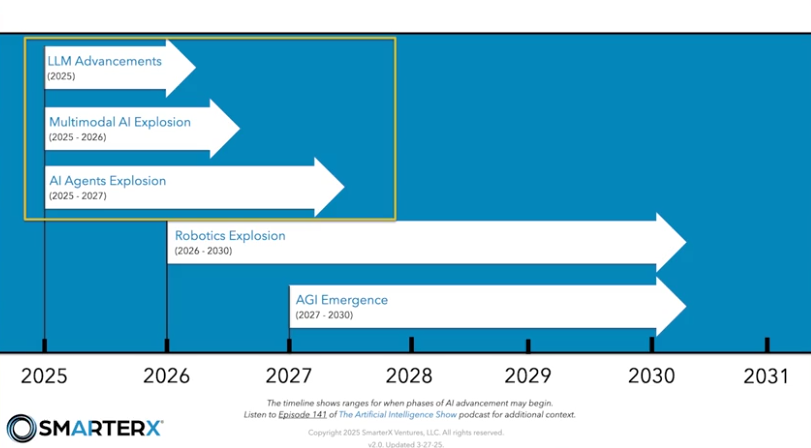
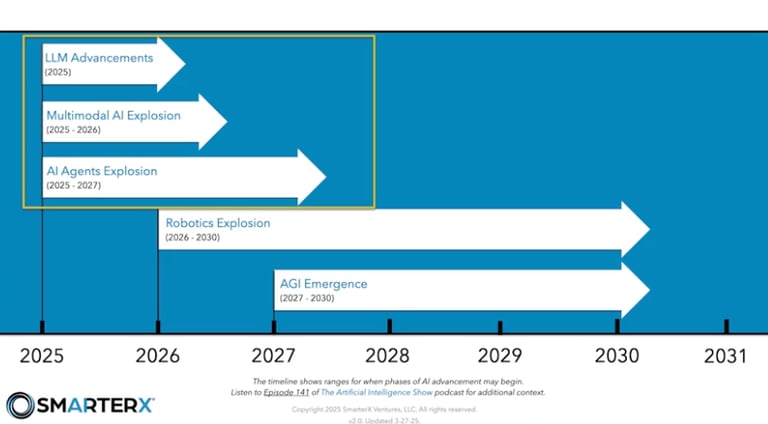
The SmarterX AI timeline shows three massive waves — software intelligence, embodied intelligence, and organisational intelligence — landing at the same time and accelerating each other. This isn’t linear evolution; it’s a compressed stack of disruptions that remove the buffer time leaders assume they have. Without AI literacy and mindset transformation, you won’t just fall behind — you won’t understand why you’re falling behind.
Most people aren’t preparing for what this AI timeline means — not because they lack ambition, but because the scale is too big for the human mind to comfortably hold. It’s the same psychological pattern we see with climate change: when a shift feels overwhelming, abstract, and uncontrollable, people default to denial… until the consequences show up in their quarterly numbers.
The SmarterX AI timeline cuts straight through that illusion of distance. It reveals something leaders can’t ignore: The next decade of technological disruption has been compressed into the next few years — and the waves are overlapping.
To understand the future of work, you first have to understand what these waves actually are.
Wave 1 (2025–2027): Software Intelligence Levels Up
This is the transition from “AI as a tool” to “AI as an intelligence layer.”
LLMs become more accurate, more reasoning-driven, and nearly free.
Multimodal models perceive the world across text, image, audio, video, and data.
Agents move from answering questions to executing work across systems.
In real terms:
Research collapses from hours to seconds.
Drafting, reporting, analysis, and insights become autonomously generated.
Multi-step workflows — onboarding, content pipelines, campaign assembly, optimisation — run end-to-end.
Every knowledge role shifts because every role is made of tasks, and these waves target tasks first. This is “software that works like a co-worker.”
Wave 2 (2026–2030): Intelligence Enters the Physical World
As agentic systems merge with robotics, the digital and physical stop being separate domains.
This affects: logistics, manufacturing, healthcare, retail and field operations. But the real disruption isn’t the hardware — it’s the fusion of intelligence and action.
Decisions stop waiting for humans, operations stop being constrained by shift patterns and work stops being limited by human attention. The cost of physical labour drops, speed and reliability increases. This is “intelligence that moves through the world.”
Wave 3 (2027–2030): The Conditions for AGI Emerge
Not a sci-fi entity, but something more practical and far more disruptive:
Reasoning systems (LLMs)
Autonomous systems (agents)
Embodied systems (robots)
Distributed systems (millions of instances operating in parallel)
Together, they form synthetic organisational intelligence. This challenges every core assumption of traditional business design: decision-making hierarchies, team sizes, managerial layers, execution bottlenecks, speed of iteration and scope of human-only roles.
This is “intelligence that scales faster than organisations can restructure.”
The Truth: This Isn’t a Timeline — It’s a Stack
Leaders love sequential models, but reality isn’t sequential.
Wave 1 doesn’t finish before Wave 2 begins.
Wave 2 doesn’t wait for Wave 3.
They stack. They compound. They accelerate each other.
This removes the buffer time leaders expect. There is no “we’ll adapt in a few years.” By then, the gap will be too large to close.
We’re not approaching the tipping point. We’re already past it. The only remaining variable is your pace of learning.
The Competence Gap: Why AI Literacy Is Now Non-Negotiable
Here’s the uncomfortable truth: If you don’t understand what these waves mean — the mechanics, the implications, the changes in cost curves, the shifts in task structures — you won’t just lose competitive advantage. You’ll lose the ability to understand why you’re losing it.
Your competitors won’t beat you with headcount. They’ll beat you with synthetic, scalable, compounding intelligence. And that requires a new kind of skillset and mindset.
CTRL / SHIFT — The Upgrade Path for the AI Era
Your page is clear: the teams that win aren’t the ones that know the most tools. They’re the ones who’ve rebuilt their mental operating system. CTRL/SHIFT is built around that idea.
CTRL → AI Literacy That Gives You Control
This is where leaders build the foundation:
Understanding the intelligence stack
Knowing what today’s models can and can’t do
Seeing where AI plugs into workflows, value chains, and decision loops
Speaking the language of AI so you can lead, not follow
Knowing how to interrogate vendors, ask the right questions, and evaluate risk vs opportunity
CTRL gives you situational awareness. It gives you clarity and it gives you agency.
SHIFT → The Mindset and Capability to Scale with AI
SHIFT is about becoming AI-native in how you think and operate:
Moving from manual processes to compounding workflows
Thinking in loops, not lines
Designing systems that learn, iterate, and self-improve
Replacing “content effort” with “content engine”
Running campaigns, optimisation, and insights at a frequency humans alone can’t match
This isn’t training. This is operational transformation.
When the three AI waves hit, CTRL/SHIFT ensures your team doesn’t just survive — they accelerate.
CTRL gives you understanding. SHIFT gives you leverage. Together, they give you competitive advantage.
FAQs
1. What is the SmarterX AI timeline and why does it matter?
The SmarterX AI timeline visualises three major AI waves hitting within a few years: software intelligence, embodied intelligence, and organisational intelligence. It matters because these waves overlap, accelerating change far faster than most leaders anticipate.
2. How will AI impact the future of work between 2025 and 2030?
AI will reshape work through autonomous agents, multimodal intelligence, robotics integration, and AGI-level capabilities emerging at scale. Knowledge tasks, operational roles, decision-making structures, and team design will all shift dramatically as these waves collide.
3. What are “stacked AI shockwaves”?
Stacked AI shockwaves refer to multiple technological breakthroughs — LLMs, agents, robotics, and AGI conditions — happening simultaneously, compounding each other's impact. This removes the buffer time organisations typically rely on to adapt.
4. Why is AI literacy now a non-negotiable leadership skill?
Without AI literacy, leaders can’t understand the mechanics, risks, opportunities, or organisational implications of fast-moving AI systems. This leads to slow decisions, poor investments, and missed competitive advantage as rivals scale with AI.
5. What will AI agents change inside organisations?
AI agents will take on multi-step workflows, decision-making, analysis, reporting, and execution across software tools. This reduces manual load, increases speed, and shifts human roles toward orchestration, judgement, and oversight.
6. How will robotics and AI combine to disrupt physical industries?
As agentic systems merge with robotics, industries like manufacturing, logistics, healthcare, and retail will gain autonomous physical capability. This lowers labour costs, speeds up operations, improves reliability, and reshapes operating models.
7. Are we really approaching AGI between 2027 and 2030?
The timeline doesn’t claim a sci-fi superintelligence emerges overnight. It shows that reasoning, autonomy, embodiment, and scale will combine to create organisational-level intelligence that outpaces traditional decision-making and team structures.
8. How can organisations prepare for these AI waves?
The most important step is building AI literacy and mindset transformation across leadership and core teams. Programmes like CTRL/SHIFT (by vibe MKTG), or The AI Academy (by Smarter X) help organisations understand the landscape, redesign workflows, and create scalable AI-native capability.